
 ISAC Student Portal
Illinois Student Assistance Commission
Language Access Program (LAP) Plan
(May 2026)
-
Policy Directives
-
General Policy
The role and mission of the Illinois Student Assistance Commission (hereinafter “ISAC”) is to provide Illinois students with information and assistance to help make education beyond high school accessible and affordable. ISAC is committed to promoting equity and inclusivity. To that end, it is ISAC’s policy to make reasonable efforts to provide limited English proficient (LEP) individuals with Language Assistance Services that provide meaningful access to ISAC’s services, programs, and activities. ISAC interacts with the public via telephone services, email, online mediums, and in person.
ISAC’s Language Access Program (LAP) Plan supports the agency’s Diversity, Equity, Inclusion, and Accessibility (DEIA) goals of formally and fully integrating DEIA programming and oversight into existing operational framework of ISAC, such as the LAP Plan, and contributing to the scale and sustainability of impactful state-wide DEIA efforts in the State. While the Illinois Language Equity and Access Act makes reference to individuals with limited English proficiency LEP, ISAC’s LAP Plan intends to support all individuals who use languages other than English as their primary language. Therefore, this Plan uses “LEP” to be inclusive of individuals who use languages other than English as their primary language, as there is no standard definition for limited proficiency of English.
In accordance with federal and state requirements, this LAP Plan provides a framework for ensuring ISAC can deliver timely and meaningful language assistance services to ISAC’s constituents with limited English proficiency (LEP). ISAC will operationalize this commitment to language access by:
- Designating a Language Access Coordinator who is responsible for overseeing the development and implementation of the Language Access Program (LAP) Plan.
- Taking reasonable steps, as described in this Plan, to provide competent, timely translation and interpretation services to LEP persons who are seeking access to information, services, programs, or activities provided by ISAC. This includes displaying signage and notices made available to ISAC by the Governor’s Office of New Americans (ONA) in frequently encountered languages that communicate the availability of free interpretation services and how to request language services.
- Conducting, as described in this Plan, regular assessment(s) that is/are informed by the factors described in the Language Equity and Access Act: (i) the number or proportion of LEP persons who are served or encountered in the eligible service population of ISAC; (ii) the frequency with which LEP persons come in contact with the services, programs, or activities provided by ISAC; (iii) the nature and importance of the services, programs, or activities provided by ISAC; and (iv) the resources available to ISAC and the costs.
- Taking reasonable steps, as described in this Plan, to provide vital document translation services for LEP persons who are seeking access to information, services, programs, or activities provided by ISAC.
- Establishing, as provided in this Plan, data collection and reporting metrics. This includes, as described in this Plan, an internal complaint and review process specific to the provision of language assistance services and ensuring complaints are addressed in a timely manner.
- Providing, as described in this Plan, employee LAP development and training.
- Ensuring the LAP Plan and related materials are publicly available through ISAC’s website (www.isac.org) and other accessible formats.
- Coordinating with the ONA to review and monitor the implementation of ISAC’s LAP Plan and ensure ongoing compliance with the Act.
-
Purpose and Authority
The purpose of this policy is to establish effective guidelines, consistent with Title VI of the Civil Rights Act of 1964, Executive Order 13166, and the Illinois Language and Equity and Access Act (15 ILSC 56) for agency personnel to follow when providing services to or interacting with individuals who have limited English proficiency (LEP). See Appendix IV – Legislative References for more information on: Title VI of the Civil Rights Act of 1964; Illinois Civil Rights Act of 2003; Illinois Human Rights Act; and Illinois Language Equity and Access Act.
-
Scope and Compliance
This Language Access Program (LAP) Plan applies to all ISAC staff.
-
Definitions
- Bilingual Staff Member – An ISAC staff member who has demonstrated proficiency in both English and at least one other language. A bilingual staff member may speak or write directly to an LEP individual in a language other than English.
- Qualified Translator or Interpreter – An in-house or contracted translator or interpreter who has a demonstrated competence as an interpreter or translator.
- Interpretation – The act of listening to a communication in one language (source language) and orally converting it to another language (target language) while retaining the same meaning.
- Language Access Coordinator – The designated staff person responsible for the oversight, training, performance, coordination, and implementation of all aspects of ISAC’s language assistance services to LEP individuals.
- Language Assistance Services – All oral and written language services (i.e., interpretation and translation services) needed to assist LEP individuals in communicating effectively with staff, and to provide LEP individuals with meaningful access to, and an equal opportunity to participate in, the services, activities, or programs administered by ISAC.
- Limited English Proficient (LEP) – Individuals whose primary language is not English and who have limited ability to write, read, speak, or understand English. LEP individuals may be competent in certain types of communication in English (e.g., speaking or understanding), but still be LEP for other purposes (e.g., reading or writing). Similarly, LEP designations are context-specific: an individual may possess sufficient English language skills to function in one setting but may find these skills are insufficient in other situations. Note: if an individual identifies him or herself as an LEP individual needing services, ISAC typically should accept that designation and provide the appropriate services.
- Primary Language – An individual’s native tongue or the language in which an individual most effectively communicates. Staff should avoid assumptions about an individual's primary language. For example, not all individuals from predominantly Spanish-speaking countries speak Spanish fluently. Staff should make every effort to ascertain an individual's primary language to ensure effective communication.
- Translation – The replacement of written text from one language (source language) into an equivalent written text in another language (target language).
- Vital Document – Paper or electronic material that is critical for access to ISAC’s services, programs, and activities, or contains information about procedures and processes required by law. Classification of a document as “vital” depends upon the importance of the program, information, encounter, or service involved, and the consequence to the LEP individual if the information in question is not provided accurately or in a timely manner. The vital documents See Appendix I – Vital Documents List. The vital documents for ISAC are the applications or application/promissory notes for the various scholarship, grant, and loan repayment programs we administer. In order to receive the benefits of these programs, an individual must be or have been in a degree-seeking program at an eligible postsecondary institution. These institutions provide their degree programs in English, not in other languages; therefore, listed vital documents are in English. General information about the programs can be made available in another language for an individual supporting a student’s education pathway.
- Meaningful Access – Language assistance that results in accurate, timely, and effective communication at no cost to the LEP individual. For LEP individuals, meaningful access denotes access that is not unreasonably restricted, delayed, or inferior as compared to access to programs or activities provided to English proficient individuals. The agency’s new website with the translation feature will greatly increase making this general information more readily available to a wider range of LEP individuals.
-
-
Language Access Assessment
-
Person charged with implementing the plan:
Eddie Brambila (Managing Director, College Access Systems) named as LEP Language Access Coordinator, supported by Sam Nelson, Director of Organizational Development.
-
Identification and assessment of services for LEP communities:
In order to assess whether there is meaningful access to programs and activities by LEP persons, a four-factor analysis is set out in guidance issued with Executive Order 13166. The four-factor analysis considers (1) the number or proportion of LEP persons eligible to be served or likely to be encountered by the program; (2) The frequency with which LEP individuals come in contact with the program; (3) The nature and importance of the program, activity, or service provided by the program to people’s lives; and (4) The Resources available to the grantee/recipient and costs.
- Factor 1: The number or proportion of LEP persons eligible to be served or likely to be encountered by the program. ISAC’s responsibilities primarily consist of providing information and resources to Illinois residents seeking post-secondary education in the State of Illinois. As a result, nearly 100% of the student population that ISAC serves is highly proficient in English. However, on occasion a student’s family member, or other person seeking assistance on the student’s behalf is an LEP individual; for these individuals ISAC will provide services to meet their language needs.
In 2026, ISAC is using the following findings from a demographic analysis[1] conducted by the University of Illinois Chicago in partnership with the Office of New Americans on the State’s individuals with limited English proficiency and individuals with LEP:
- In Illinois, 1.0 million residents speak English less than "very well," and speak a language other than English at home. Both federal and state policies recognize that these individuals have a right to equitable access to government services, which includes information and communication in a language they understand.
- Eleven languages have more than 10,000 limited-English speakers in Illinois, including:
Largest Language Groups and Largest Limited•English Language Groups In Illinois: 2018-2022 Largest Language Groups Largest Limited-English Language Groups # of Speakers # of Speakers Spanish 1,638,222 Spanish 616,760 Polish 169,308 Polish 73,843 Chinese* 106,399 Chinese* 51,494 Filipino, Tagolog 86,051 Filipino, Tagolog 23,198 Arabic 67,017 Arabic 20,342 Urdu 56,122 Korean 20,165 Gujarati 50,196 Gujarati 18,762 Hindi 47,274 Russian 17,649 Russian 44,211 Vietnamese 13,966 Korean 39,624 Urdu 13,893 French 36,728 Ukraninlan, Ruthenian, Little Russian 11,817 - The predominant language other than English in many Illinois counties may be Spanish, but closer examination of the most common non-English languages shows that immigrants and migrants come to Illinois from many places. For example, in Champaign County, the top language spoken in limited English households is Mandarin, and in Macon County, it is Tagalog. Additionally, in Cass and Knox counties, the second language is French/Haitian/Cajun. In Madison County, it’s Tagalog. In Cook, DuPage, and Kane counties, the second language category is Slavic. In Boone County, “other Asian Pacific Islander” is second to Spanish.
- A statewide map of persons who don’t speak English very well shows that the largest numbers of such persons are in the metro Chicago area. Nevertheless, significant numbers of up to 9 thousand are located in townships across the state and are often located near metro areas such as St. Louis, Springfield, Champaign, and Rock Island. There are also notable populations in relatively rural townships in counties such as Cass, Douglas, or Union.
- After years of decline, the number of Illinois residents who don’t speak English very well is on the rise. In examining ten years, from 2014 to 2023, this population fell by 79,000 persons between 2014 and 2019. But since a low of 1.0 million in 2019, the most recent data, for the year 2023, shows about 1,082,000 persons, for a gain of some 82,000.
[1]See Rob Paral, “Language Needs Assessment Report,_ Office of New Americans, Office of the Governor of Illinois, Great Cities Institute at the University of Illinois Chicago (2025), https://arcg.is/1Py4n0
- Factor 2: The frequency with which LEP individuals come in contact with the program. Generally, all contact with ISAC is made through outreach events hosted by other organizations at which ISAC is a guest speaker, telephone, mail, email, and ISAC’s public website. As noted above, the proportion of LEP individuals to the population ISAC serves is extremely low, so the contact with LEP individuals is infrequent.
- Factor 3: The nature and importance of the program, activity, or service provided by the program to people’s lives. ISAC is unique in that it serves the People of the State of Illinois who are seeking higher education. Although college is an important aspect of a person’s life, it is not critical to their liberty, health, safety, or other vital needs.
In order to receive any of the scholarship and grant programs provided through ISAC, students must be enrolled in a degree-seeking program at an eligible postsecondary institution in the State of Illinois. These financial aid eligible programs are provided in English; hence, students need to have proficiency in English in order to be enrolled in these financial aid eligible programs and receive the financial aid assistance these programs provide.
ISAC provides program information and services to all individuals in the state seeking postsecondary education. The majority of our outreach services and activities are with current high school students at the request of high school counselors and administrators, or professionals from a community-based or non-profit organization supporting students, reaching out to ISAC for that student assistance and support for the college going and financial aid process.
These services include one-on-one and small group meetings with students, as well as college admission and financial aid workshops and presentations. While most workshops and presentations are done in English, some workshops and presentations may be done in Spanish, as ISAC has Spanish speaking outreach staff, when the audience may include parents and other family members supporting their student who are LEP individuals. These are not ISAC sponsored or hosted presentations; these are events hosted and sponsored by the school or other organization. ISAC staff are guest speakers and do not determine who attends or if registration or security processing is required to attend the event (e.g., some events are in school buildings that might have certain security requirements). While these presentations events are not ISAC sponsored, the agency does track and can report how many events for external partner hosted events are provided in Spanish as guest speakers.
- Factor 4: The resources available to ISAC and the costs of providing LEP services. ISAC, as all state agencies, has a limited budget. The cost of the foregoing services has been manageable.
- Factor 1: The number or proportion of LEP persons eligible to be served or likely to be encountered by the program. ISAC’s responsibilities primarily consist of providing information and resources to Illinois residents seeking post-secondary education in the State of Illinois. As a result, nearly 100% of the student population that ISAC serves is highly proficient in English. However, on occasion a student’s family member, or other person seeking assistance on the student’s behalf is an LEP individual; for these individuals ISAC will provide services to meet their language needs.
-
Language Assistance Measures
- ISAC has identified that Spanish is the primary language of most LEP individuals ISAC encounters. Interpretation services are mostly conducted by ISAC bilingual staff and may include but are not limited to oral interpretation conducted in-person or via telephone or other means or written translation by qualified translators.
- LEP individuals are also allowed to provide their own interpreters or have family members interpret if they choose.
- ISAC has not yet had a need to hire outside interpreters for an LEP individual.
- ISAC has translated program support materials, checklists and information sheets into non-English languages (in Spanish) using third-party qualified translators or bilingual staff. ISAC has not had a need to translate vital documents for an LEP individual. As ISAC works to implement. ISAC is also transitioning away from providing PDFs of information in order to comply with the Illinois Information Technology Accessibility Act (IITAA) and the U.S. Department of Justice’s published a rule requiring state websites to meet the World Wide Web Consortium's Web Content Accessibility Guidelines (WCAG) 2.1 Level AA by April 24, 2026. Information will be provided on the agency website in a format that meets the accessibility requirements.
- ISAC conducts programs and services by collaborating and contracting with a network of businesses and non-profit entities. ISAC will work to ensure that those entities, whenever possible in compliance with any other federal or state law, support meaningful access by LEP persons.
-
-
Procedures
- ISAC identifies LEP individuals who contact ISAC through correspondence (via U.S. mail, fax, e-mail, or website inquiry), telephonically or in person, and who may need language assistance. At an ISAC office location, visitors will be met with posted information on LEP services and how to access them. All public-facing employees will receive training on offering and providing LEP services. ISAC staff will offer free LEP services to all students, a student’s family member, or other person seeking assistance on the student’s behalf if that person is an LEP individual.
As ISAC shares offices space in our Deerfield office building with a common public lobby area with the Illinois Department of Children and Family Services (DCFS) and the Illinois Department of Veterans Affairs (IDVA), ISAC will work with the other two agencies to coordinate language resources information and signage to be displayed in the lobby area.
- Determining Need for Language Assistance Services:
- Guidelines for Identifying LEP individuals include:
- At first contact with a LEP-possible client, staff will take reasonable steps to assess whether the client needs language assistance services. These steps include the following: staff member asking professional, open-ended questions of the LEP-possible client to determine the individual’s ability to speak or understand English. Open-ended questions are those that require a complex, non-static response, such as “who”, “what”, “when”, “where”, and “why”. Examples of open-ended questions include: “What kind of assistance do you need from ISAC?”; “Why do you need this assistance?”; and “What is your understanding of this program?”.
- ISAC use’s Cisco’s Finesse Interactive Voice Response (IVR) system for incoming phone calls to ISAC. The IVR provides callers an option to speak with someone in Spanish, and that call is routed to a Spanish speaking representative.
- If the staff member determines that the LEP-possible client is proficient in understanding and speaking English, the staff member will ask the LEP-possible client whether they need assistance in reading or writing English.
- If the LEP-possible client makes an oral or written request for translation or interpretation services in a specific language, the client will be considered as LEP.
- Upon determining the need that language assistance services are needed for a LEP individual, ISAC will make efforts in accordance with its LAP Plan to ensure that necessary communications are conducted by bilingual staff members or other qualified interpreters. If there are no available ISAC staff who can serve as interpreters, the contracted vendor for such services will be contacted.
Note: An individual with LEP may provide an interpreter of his or her own choosing at his or her own expense. Extra caution should be exercised when the LEP person chooses a minor as the interpreter. While the decision of an individual with LEP should be respected, there may be issues of competency, confidentiality, or conflict of interest when the choice involves using children as interpreters. The interpreter provided by the LEP individual should be used as a supplement to the interpreter services provided by ISAC.
- ISAC will take reasonable steps to ensure that LEP individuals are provided meaningful access to ISAC’s vital documents by providing a qualified interpreter or bilingual staff member to interpret key provisions in the LEP individual’s primary language.
- References on ISAC’s website related to ISAC’s programs, services and activities may be translated into the most frequently encountered LEP language (to date, Spanish). As of this revised LAP plan (November 2025), ISAC is in the process of developing and launching a new website in summer 2026. The new website will be incorporate a translation tool called WeGlot that offers translation into other languages through Illinois DoIT (https://wcmauthorguide.illinois.gov/useful-resources/weglot/weglot-installation.html).
- If ISAC requires a translator or interpreter in a language for which ISAC has no in-house resources, ISAC will procure the appropriate professional through the State of Illinois master contracts for interpreter and translation services by submitting a request to the ISAC Procurement Department via email at [email protected]. The ISAC Procurement Department staff will follow the guidance from and processes established by the Chief Procurement Office-General Services (CPO-GS) to obtain the interpreter or needed translation services using Multilingual Connections (BidBuy #19-416CMS-BOSS-P-8618, expires 5/13/2026.
- Guidelines for Identifying LEP individuals include:
- Procuring Telephonic Interpretation Services
- ISAC's Student Engagement Center phone number 800-899-4722 is set up with an Interactive Voice Recognition (IVR) unit. When a call is received, the IVR guides the caller through the system based upon the responses. Based on those response, the IVR may be able to answer the inquiry, or the call may choose to speak with an agent. ISAC has dedicated Spanish-speaking staff located in its Student Engagement Center.
- Per the State’s master contract, Propio Language Services provides three-way phone interpretation.
- When an ISAC staff member identifies that Proprio Language Services for a three-way phone interpretation are needed for an LEP individual, they will dial the assigned phone number along with the access code from an ISAC issued phone number that has been set-up with Propio by ISAC’s Telecom Coordinator.
- ISAC’s Telecom Coordinator will complete an Illinois Department of Innovation & Technology (DoIT) Telecommunication Service Request (TSR) requesting Propio services for designated ISAC phone numbers via requests for service from ISAC’s Student Engagement Center submitted via email to [email protected]. The TSR will include ISAC’s information including phone numbers for Propio services (phone numbers cannot be cell phone numbers. The TSR information is also used for invoicing and accounting purposes.
Using Telephone Interpretation Line
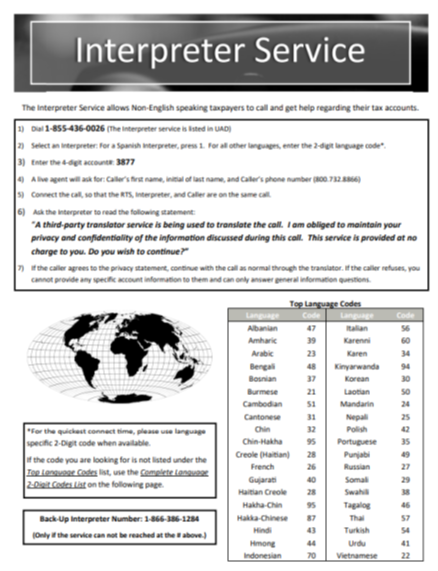
- Dial: 1-866-828-3280
- When prompted:
- For a Spanish interpreter – Press 1
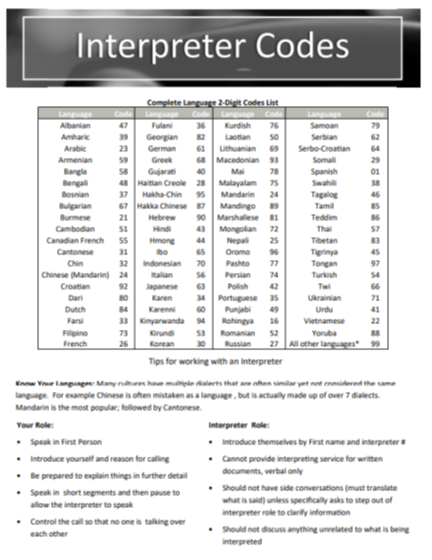
- For all other languages – Press 2, and then enter the 2-digit language code (see Proprio Language Interpretation Directions, Appendix II)
- Enter the assigned by DoIT 5-digit account#:
- Provide to agent:
- Caller’s first name and initial of last name and work number with area code
- For a Spanish interpreter – Press 1
- For all other languages – Press 2, and then enter the 2-digit language code (see Proprio Language Interpretation Directions, Appendix II)
- For 3-way calls: Ask the first person who answers (interpreter or call coordinator) to place the call.
- Back-Up Interpreter Number: 1-866-386-1284 (Only use if interpreter is unavailable at primary number above)
- ISAC Student Engagement Center staff will keep a log of the services used and will share that information with ISAC’s Telecom Coordinator for billing reconciliation purposes. Once the telephonic call is concluded, the ISAC staff member will confirm with their supervisor, who will confirm with the ISAC Telecom Coordinator that Propio services for this request are complete. This confirmation assists with invoice and accounting purposes.
- ISAC’s Telecom Coordinator will complete an Illinois Department of Innovation & Technology (DoIT) Telecommunication Service Request (TSR) requesting Propio services for designated ISAC phone numbers via requests for service from ISAC’s Student Engagement Center submitted via email to [email protected]. The TSR will include ISAC’s information including phone numbers for Propio services (phone numbers cannot be cell phone numbers. The TSR information is also used for invoicing and accounting purposes.
- There is a telephonic interpretation feedback mechanism. Questions, concerns, or feedback with regard to the telephonic interpreter session, including the quality of the telephonic interpretation, should be made directly to ISAC’s General Counsel, Procurement, and Telecom staff.
- Procuring Translator or Interpreter Services
- Per the State’s master contract, Multilingual Connections provides interpretation services for person-to-person interaction, as well as for other settings, and for translation services. Requests for American Sign Language (ASL) interpretation services should be made at least 5-10 business days in advance.
- Mail and Email Correspondence
- ISAC’s Spanish-speaking staff are available to provide responses via postal and e-mail correspondence to LEP individuals with Spanish language understanding. ISAC staff will respond to correspondence typically within two business days.
- When an ISAC staff member identifies that interpretation or translation services are needed from Multilingual Connections to provide services to an LEP individual, they will notify their supervisor who will contact’s ISAC’ Procurement Department at [email protected] to initiate the procurement process for the use of the State’s master contract. Requests should be made 5-10 business days services needed and should include the type of service needed and in what language and the duration (as multiple interpreters may be required depending on the length of engagement with an LEP. Procurement staff will obtain the needed services using Multilingual Connections (BidBuy#19-416CMS-BOSS4-P-8618, expires 5/13/2026.
- See Appendix III – In-House Translation Review and Feedback Mechanism for in-house translation guidelines.
- To help ensure ISAC provides LEP individuals have quality interpreters for virtual communication (e.g., over-the-phone or video) services when interacting with agency staff for access to agency programs and services, within 90 days after issuance of this revised LAP, ISAC’s LEP Language Access Coordinator will assess its anticipated interpretation and translation needs, and on a semi-annual basis, ISAC’s General Counsel, Procurement, and Telecom staff will ensure proper management and administration of these two contracts. ISAC will work to identify and may designate points of contact from agency divisions and departments that are likely to use the services under these two contracts. In addition, the Language Access Coordinator will meet with College Access Services Division and Program Services and Compliance Division leadership to assess the quality of in-person services to LEP individuals.
- There is an interpreter feedback mechanism. Questions, concerns, or feedback with regard to the telephonic interpreter session, including the quality of the telephonic interpretation, should be made directly to ISAC’s General Counsel staff at [email protected] & Procurement Department staff at [email protected].
Complaints may also be made to:
Illinois Deaf and Hard of Hearing Commission (IDHHC)
Attn: Interpreter Complaint Department
528 South 5th Street, Suite 209
Springfield, IL 62701
Voice: 877-455-3323 or 217-557-4495*
Video Phone: 217-303-8010
TTY: 888-261-2698
Fax: 217-557-4492
https://www.illinois.gov/idhhc/community/Pages/InterpreterComplaint.aspx*For individuals calling the “voice” number, IDHHC calls are directed through the Federal Communications Commission’s video relay system to accommodate Deaf staff.
To elevate any complaints not adequately addressed through the above processes, complaints and concerns may also be made to the Governor’s Office of New Americans (ONA) at [email protected].
- Teletype Device (TTY)/Telecommunication Device for Deaf (TDD)
- A TTY and TDD are auxiliary aids and services for individuals with hearing impairments. A relay system makes it possible for individuals who are deaf to use TTYs to call other people who may not have a TTY.
- Illinois has the Illinois Relay Center (IRC), also known as "Dual Party Relay." IRC is a 24-hour-a-day, seven-day-a-week service which provides a communications link between those who use a TTY and those who use a standard voice telephone. Those using a TTY can reach ISAC by dialing 888-899-4722 or dialing 7-1-1.
- ISAC Language Access Complaint Process
- Based on information provided by the Governor’s Office of New Americans (ONA), ISAC is in the process of working the agency’s General Counsel office to adapt the ONA’s Complaint Form Best Practices and template information shared November 2025. This complaint process is being developed and implemented to expand upon the complaint process described in section D.6. above.
- In addition to ISAC’s IT division creating an integrated system to report and record the delivery of language access services to LEP individuals across ISAC divisions, they will also be creating an integrated complaint tracking process.
- LAP Training for ISAC Staff
- ISAC is committed to providing ongoing employee development and training on language access services to maintain well-trained bilingual employees, general staff, and all public-facing staff who interact with or may interact with individuals with LEP. This ongoing professional development and training on language access provides information on policies, procedures, and responsibilities, and it ensures ISAC is equipped to deliver effective language assistance services. This section outlines the type of language access training to provide all ISAC personnel, as well as specific training responsibilities for bilingual or multilingual employees, frontline staff, and other personnel who may interact with individuals with LEP. This section also identifies the timing, frequency, and delivery methods for how training shall be implemented across the agency and its divisions.
- ISAC staff who interact with the public receive training on how to access and provide language assistance services to LEP individuals as described above. The key public-facing staff at ISAC includes: staff from the Division of College Access Services, including the ISACorps of near-peer mentors; and staff from the Division of Program Services and Compliance in the Student Engagement and Support Services department (i.e., call center) and the Program Operations department.
- This training is provided in collaboration with ISAC’s Human Resources & Development (HRD) Division staff and division management as part of new employee on-boarding, or when a current staff member transitions into a public-facing position, when changes are made to the LAP, and in support of the agency’s Diversity, Equity, Inclusion, and Access (DEAI) planning and staff development. ISAC ensures that relevant bilingual staff also are knowledgeable in ISAC’s services, programs, and activities.
- Training materials are being updated to include information from the Illinois Language Equity and Access Act, including the new reporting requirements and other guidance from the ONA. In addition to detailed training being provided to public-facing staff as they move into a new position and on an annual basis for all public-facing staff, ISAC will be expanding training about the agency’s ability to provide services to persons whose primary language is not English to all agency staff who are not in a public-facing role on an annual basis.
The training for all agency staff who are not in a public-facing role will be more general without the level detail required for public-facing positions but will include how staff can be aware of our language access services in the event they encounter LEP individual in a personal or professional and to whom at ISAC public-facing staff to direct that individual. This all-staff training will help raise aware that the agency does have the capacity to provide services to LEP individuals and the importance in providing services to persons whose primary language is not English to promote a culture of understanding and broader support.
- Depending on the circumstance and staff location, training be provided virtually in a synchronous manner or in-person in a synchronous manner or virtually in an asynchronous manner.
- ISAC is in the process of implementing a new online training system – Articulate 360 – to provide professional development and training programs and services for both external and internal clients. We will be adding LAP Plan training modules to Articulate 360 for our ISAC staff, both the all-staff trainings and the public-facing staff trainings.
- Bilingual ISAC Staff – ISAC’s Human Resources Division (HRD) does not currently track all agency staff who are bilingual. Only staff with public facing work positions with bilingual responsibilities are recorded and noted. HRD is working with the Language Access Coordinator to determine if a separate staff survey to identify this information is most efficient or to incorporate requesting this information as part of the public-facing staff training and the all-staff general training.
- Language Access Awareness Materials
- Based on the information shared by the Governor’s Office of New Americans (ONA) and consultants from Leap Consulting, ISAC’s Language Access Coordinator is working with the agency’s Marketing Communications Division to identify the scope of language access awareness materials (e.g., I-Speak cards for in-person interactions by staff, awareness posters for display in ISAC office, promotional materials to share with professional partners/school counselors, language to support the online website translation service being incorporated into the agency new website, etc.) needed to support LEP individuals making use of ISAC programs and services to go through the state procurement process to secure a vendor(s) to design and produce materials to service LEP individuals. Design will take into account examples shared by ONA and Leap Consulting.
- This process of reviewing examples provided by ONA and Leap Consulting is providing ISAC with the opportunity to review and improve both our digital and physical public notices of language access services. These notices will clearly explain how individuals can request interpretation or translation services and will be made available in the most frequently spoken languages identified through demographic analysis and the State’s Language Needs Assessment Report.
- Data Collection, Monitoring, Evaluation, and Reporting
- In order to ensure that all ISAC encounters with individuals with LEP across programs and services are collected in a comprehensive and ongoing manner, ISAC will:
- Collect data on encounters with individuals with LEP that take place in person, by telephone, written mail, e-mail, and through online platforms, as well as being guest speakers at events hosted by external partners (e.g., high schools, non-profit and community-based organizations);
- Track the languages encounters and types of language assistance services requested and/or provided during those encounters; and
- Conduct regular assessments and identify high-volume languages and the most frequently requested or needed language assistance services to ensure meaningful access that is accurate, timely, and effective at no cost to persons with LEP.
- ISAC currently tracks various interactions (phone calls, emails, written mail, texts, in-person, field work and presentations) with LEP individuals by different agency division staff that respond to a LEP individual in the course of their work with clients, from which the Language Access Coordinate gather the data for the agency reporting and review. Starting with Fiscal Year 26 (7/1/2025 - 6/30/2025), ISAC’s Information Technology division is working to create a more unified/streamlined integrated tracking and report process for language assistance services provided other than English.
- In order to ensure that all ISAC encounters with individuals with LEP across programs and services are collected in a comprehensive and ongoing manner, ISAC will:
Appendix I – Vital Documents – (Reviewed and updated 11/24/2025)
Public Service Loan Forgiveness (PSLF) Presentation Request Form
Free Application for Federal Student Aid (FAFSA®) – for Monetary Award Program (MAP) Grant
Alternative Application for Illinois Financial Aid
Illinois National Guard (ING) Grant Program Application
Illinois Veteran Grant (IVG) Program Application
Deceased, Disabled, and MIA-POW Veterans’ Dependents Scholarship Application
Grant Program for Dependents of Police or Fire Officers Application
Grant Program for Dependents of Correctional Officers Application
Grant Program for Exonerees Application
Minority Teachers of Illinois (MTI) Scholarship Program Application/Teaching Agreement/Promissory Note
Illinois Special Education Teacher Tuition Waiver (SETTEW) Program Application/Teaching Agreement/Promissory Note
Early Childhood Access Consortium for Equity (ECACE) Scholarship Program Application/Promissory Note
Displaced Energy Worker Dependent Transition Scholarship Program Application
Post-Master of Social Work School Social Work Professional Educator License Scholarship Program Application/Promissory Note
Optometric Education Scholarship Program Application
Nursing Education Scholarship Program (NESP) Application/Promissory Note/Grant Agreement
Nurse Educator Loan Repayment Program Application
Community Behavioral Health Care Professional Loan Repayment Program Application
Illinois Teachers Loan Repayment Program Application
John R. Justice Student Loan Repayment Program Application
School and Municipal Social Work Shortage Loan Repayment Program Application
Veterans’ Home Medical Providers’ Loan Repayment Program Application
Golden Apple Scholars of Illinois
Deceased, Disabled, and MIA-POW Veterans' Dependents Scholarship
Illinois Graduate and Retain our Workforce (iGROW) Tech Scholarship Program
Human Services Professional Loan Repayment Program
State Scholars Program
Appendix II – Propio Interpretation Procedures
Accessed current card info at https://doit.illinois.gov/content/dam/soi/en/web/doit/documents/services/catalog/telecom/Propio-Interpreter-Insructions.pdf and list of all codes information https://propio.com/language-codes/ – 4/30/2025
PROPIO INTERPRETER CHANGES
As DoIT continues to strive to make the Propio Tele interpreter customer experience as user friendly as possible, we have implemented some changes to the process of connecting with an Interpreter to streamline DoIT’s process of handling Interpreter calls.
The New Propio Instruction Card Template below is how new request access cards will look. If you have the old card format, please use the new format below to access an interpreter in the future.
If you have any questions, please contact [email protected] or call 217-557-1652.
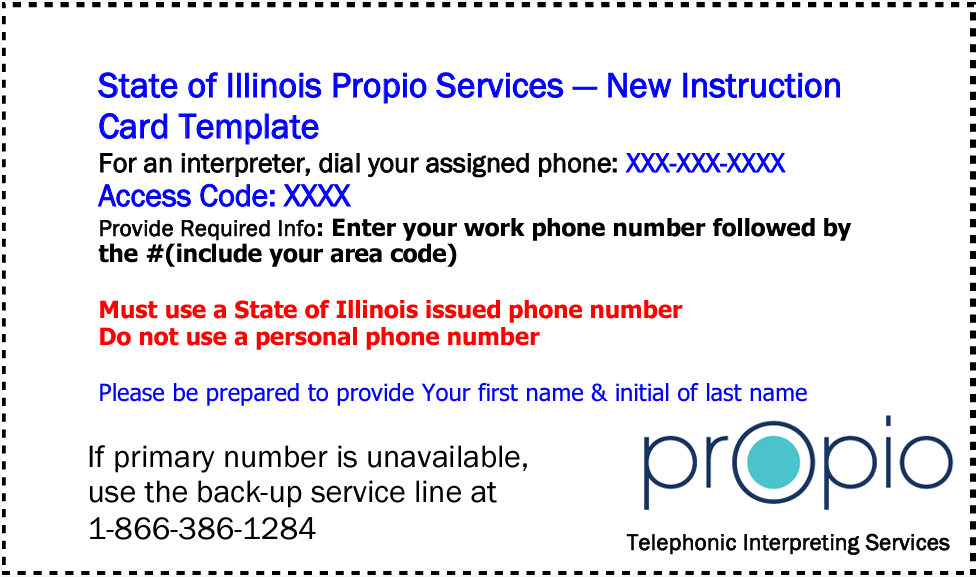
State of Illinois Propio Services- New Instruction Card Template
For an interpreter, dial your assigned phone·: XXX-XXX-XXXX Access Code: XXXX
Provide Required Info: Enter your work phone number followed by the #(include your area code)
Must use a State of Illinois issued phone number
Do not use a personal phone numberPlease be prepared to provide Your first name & initial of last name
If primary number is unavailable, use the back-up service line at 1-866-386-1284
Top Language Codes
Amharic 39 Kinyarwanda 94 Arabic 23 Korean 30 Bengali 48 Mandarin 24 Burmese 21 Nepali 25 Cantonese 31 Portuguese 35 French 26 Russian 27 Haitian Creole 28 Somali 29 Hakha-Chin 95 Swahili 38 Hmong 44 Vietnamese 22 Karen 34 All Other 8 Complete list online: LanguageCodes.info
Appendix III – In-House Translation Review and Feedback Mechanism
Employees reviewing translations and/or those requesting internal reviews should follow these guidelines to ensure quality. The process can be divided into three broad steps.
- Preparing materials.
- The English text is evaluated for readability, clarity, and cultural appropriateness.
- Ensure
- correct reading level,
- language is simple and clear,
- messages and illustrations are culturally appropriate,
- translatability of the English document, and
- document is appropriately formatted for accessibility.
- If materials will be distributed in hard copy (Word, PDF, etc.) they should be formatted so that they can be made available upon request in formats that are accessible to individuals who use assistive technology as required under the Americans with Disabilities Act and Section 504 of the Rehabilitation Act.
- Document prints clearly in black and white if it will be posted on the internet for public download.
- If contact information is listed, program must have capacity to interface with people who are LEP. In most cases, having Telephonic Interpreter Services solves the issue. The availability of such services should be listed on your materials.
- Whenever possible and appropriate, you should have your English materials field-tested prior to getting them translated.
- English version of document is submitted to the appropriate ISAC Division/Department management staff for review and approval.
- Translation.
- The initial translation is performed.
- Program staff should discuss the following with the translators:
- purpose of the material
- appropriate reading level of the target population
- key messages, and
- terminology specific to the message
- The translator needs to be encouraged to ask questions, because the quality of the translation is dependent upon the translator’s understanding of the English document.
- A conceptual translation should be used, as opposed to a word-for-word, sentence-by-sentence translation. This method allows the translator to select from a variety of ways to express the message to the target audience. The use of a non-literal methodology conveys the intended message in a more culturally relevant way than the use of literal or a word-for-word translation.
- Use two translators – one for the initial translation and the second to review and edit the translation, checking for accuracy, tone, and appropriateness. The translation is given to a second translator who will check style, grammar, accuracy, and comprehension of the messages. The second translator will also review the literacy level of the translation.
- If Multilingual Connections is to be contracted for translation services, ensure that editing by a second translator is provided and that this cost is included in the price estimate.
- Revision/Editing.
- “Back-to-English” translation is not recommended as an effective method to ensure effectiveness.
Translated materials, too, should be field-tested. A simple way of doing this is by working with community providers, community members, and/or bilingual ISAC staff. They can review your documents and provide valuable input.
Appendix IV – Legislative References
Title VI of the Civil Rights Act of 1964 – Title VI of the Civil Rights Act of 1964 (42 U.S.C. § 2000d) (Title VI) prohibits discrimination on the basis of race, color, or national origin in any program or activity receiving federal financial assistance. As a recipient of federal financial assistance, the [Department/Agency] is bound by Title VI of the Civil Rights Act of 1964 (Title VI), 42 U.S.C. §§ 2000d-2000d-7, and its implementing regulation, 45 C.F.R. Part 80, which prohibits discrimination based on race, color, or national origin (which includes Limited English Proficiency).
Illinois Civil Rights Act of 2003 – The Illinois Civil Rights Act prohibits State, county, or local government in Illinois from excluding a person from participation in, denying a person the benefits of, or subjecting a person to discrimination under any program or activity on the grounds of that person’s race, color, national origin, or gender. Additionally, the Illinois Civil Rights Act prohibits using criteria or methods that have a discriminatory effect.
Illinois Human Rights Act (IHRA) – The Illinois Human Rights Act consolidates existing laws and administrative processes addressing civil rights in Illinois. IHRA prohibits discrimination in employment, housing, financial credit, and public accommodations because of race, color, sex, religion, ancestry, national origin, age, physical or mental disability, unfavorable military discharge, and marital status, as well as retaliation for opposing discrimination. IHRA established the Illinois Department of Human Rights (IDHR) and the Illinois Human Rights Commission (IHRC) as enforcing agencies.[1]
Illinois Language Equity and Access Act – Signed into law by Governor Pritzker in 2024, the Language Equity and Access Act 2024 aims to ensure that all residents can access state information, programs, and services equitably, and that limited English proficiency does not prevent anyone from fully participating in civic life.[2] The Act aims to ensure all Illinois residents, including individuals with LEP, have meaningful and equitable access to state services, programs, information, and activities by removing language barriers. The act incorporates federal guidance for ensuring meaningful access for individuals with LEP and other federal and state legislation that prohibit discrimination based on national origin and promote language access, including Title VI of the Civil Rights Act of 1964, the Illinois Human Rights Act of 1979, and the Illinois Civil Rights Act of 2003.[3]
The Act designates the Governor’s Office of New Americans (ONA) as the lead agency responsible for coordinating the implementation of statewide language access policy, with the support of the Department of Human Services. ONA is tasked with providing oversight, offering technical assistance, and ensuring agency compliance with the Act’s requirements.
Under the Act, the ONA will lead the development of a Language Needs Assessment Report using U.S. Census data to identify the languages spoken across Illinois and inform agency planning. All state agencies will develop Language Access Plans that will inform how the agency will ensure meaningful access to individuals with LEP, appoint a Language Access Coordinator (LAC) to oversee implementation within each agency, and translate vital documents and provide qualified interpretation services for LEP populations.
[1] https://dhr.illinois.gov/about-us/directors-office/agency-overview-and-history.html
[2] See Language Equity and Access Act, Public Act 103-0723, 103rd Gen. Assem. (Ill. 2024), https://www.ilga.gov/legislation/publicacts/fulltext.asp?Name=103-0723.
[3] See Language Equity and Access Act, Pub. Act 103-0723.
- ISAC identifies LEP individuals who contact ISAC through correspondence (via U.S. mail, fax, e-mail, or website inquiry), telephonically or in person, and who may need language assistance. At an ISAC office location, visitors will be met with posted information on LEP services and how to access them. All public-facing employees will receive training on offering and providing LEP services. ISAC staff will offer free LEP services to all students, a student’s family member, or other person seeking assistance on the student’s behalf if that person is an LEP individual.